Q&A with Bella Marshall, Senior Manager of Business Development (Western Canada)
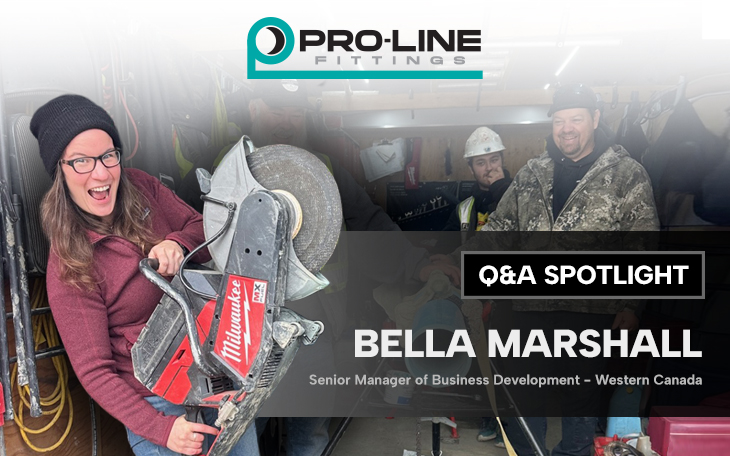
As Senior Manager of Business Development for Western Canada, Bella Marshall plays a key role in supporting distributors, municipalities, and manufacturing partners across the region. Her work focuses on understanding local needs, strengthening technical relationships, and identifying opportunities where Pro-Line’s products can add value in a changing market. In this Q+A, Bella shares her perspective on emerging infrastructure trends, the importance of clear communication, and how long-term partnerships are built in a sector that relies heavily on trust, accuracy, and responsiveness.
Can you tell us a bit about your background and how you got started in the waterworks industry?
My first exposure to the waterworks industry came while working in wholesale as a quotations administrator during what was meant to be a gap year in my post-secondary education. Prior to wholesale, I was studying cognitive psychology. Industries like wholesale and waterworks were not ones I had given much thought to, but I quickly found that I enjoyed the competitive nature of the waterworks market, and it soon became one of my favourite segments to work in.
It was a difficult choice when I was offered the option to continue working in wholesale or return to university, but I ultimately decided to stay. That decision has turned out to be one of the best of my life, opening countless doors, including the opportunity to join Pro-Line Fittings, where I now focus exclusively on waterworks fittings and products.
What drew you to Pro-Line Fittings and what has kept you engaged since joining the team?
The team at Pro-Line is what drew me to the company. Having worked with the sales staff and management during my time in wholesale, I knew I was joining a group of professionals who were not only experts in their field but also highly passionate and motivated.
As I lacked much of the deep technical knowledge, I wanted to join a company with an established group of knowledgeable people to learn from. The fact that it’s a small but tight-knit group makes it extremely enjoyable to come into work each day, and I’m grateful for the colleagues I get to work with and learn from.
How would you describe your role as Senior Manager of Business Development for Western Canada?
I would describe the title itself as a mouthful. My general focus is expanding our market presence, identifying related markets our products can cross into, and developing relationships with new and existing customers and manufacturing partners. My goal is always to add value to the relationships we have with our wholesale, manufacturing, and municipal partners. Each type of relationship requires a different value-add. My job is to find it and enhance it to the equal benefit of all parties.
What do you think sets the Western Canadian market apart from other regions in the waterworks sector?
Fundamentally, I don’t believe there is a huge difference between the Eastern and Western Canadian markets in terms of customer expectations. There may be some regional differences in the products municipalities specify or that contractors prefer to use.
But in my experience, regardless of region, the most important thing is to provide timely and accurate information, go the extra mile to help partners, and listen to customers’ issues to better understand and solve them.
From your perspective, what trends or innovations are shaping the future of water infrastructure?
Climate change is going to have a major impact on our industry. We’re seeing more extreme weather patterns globally. Wildfires, droughts, floods, and storms have become growing issues in Canada over the past decade with so many once-in-a-lifetime occurrences.
These challenges will force local, provincial, and federal governments to rethink their approach to waterworks infrastructure and urban planning. Solutions such as permeable pavements, large-scale rainwater harvesting systems, stormwater management tools, and bioswales will become increasingly common over the next few decades.
Beyond infrastructure resilience, I believe the biggest changes will come from digital monitoring. Tools that help municipalities detect leaks, optimize filtration and purification systems, or identify small blockages in sewer systems before they grow into larger and more costly problems will be transformative.
Looking back, what’s a project or milestone you’re particularly proud of?
What I’m most proud of, though not something I directly contributed to, is the growth of the waterworks industry in welcoming more women. When I attended my first waterworks meetings and trade shows, I noticed how few women were present. But in the last 10 years, there has been a dramatic shift, with more women entering and leading in our industry.
For me, the pride comes from seeing our industry become more inclusive of non-traditional demographics. I believe this will make us more sustainable and resilient in the long term, especially as we lose more key industry members to well-deserved retirement.
What’s one lesson you’ve learned from working with municipalities and distributors over the years?
Clear and concise communication is everything. So many things can go wrong for wholesalers, contractors, and suppliers if information isn’t communicated in a timely and clear manner.
If you feel part of a design won’t work, let the customer or engineer know and explain why. If you know a shipment will be delayed, call the customer immediately so you can work on another solution. Doing nothing and hoping for the best is a recipe for delayed jobs, upset customers, and a tarnished reputation.
And lastly, don’t take things personally. At the end of the day, this is a business, and decisions get made that are out of our control. Instead of ruminating on a loss, try to gain insight into the reasoning behind it and make a mental note so you’re better prepared for the next opportunity.
How do you approach building long-term relationships in such a technical and trust-based industry?
The biggest thing is not pretending you know everything. Don’t be afraid to say, “Great question, I don’t have the answer at the moment, but let me do some research and get back to you.”
There is so much to know in our industry, and giving the wrong piece of information or advice could be costly. These moments also give you the chance to expand your own knowledge base while researching the answer, and sometimes they lead to insights you hadn’t considered before.
Outside of work, what do you enjoy doing or what keeps you inspired?
There is nothing I love more than self-propelled outdoor activities, whether it’s backpacking, cycling, rock climbing, kayaking, hiking, snowboarding, or simply walking my pup along Dallas Road or up Mount Doug.
I’m grateful to live in a part of the world that allows me to enjoy the outdoors year-round in so many different ways. Summiting a mountain with friends and taking in the beauty of a snow capped range is always a good reminder of what life is all about.
Finally, what advice would you give to someone starting out in the waterworks field today?
While it can be an intimidating market to enter, waterworks is an amazing industry to be part of. As the global population grows, the need to develop and maintain clean water and sewer distribution systems will only increase, as will the need to protect our freshwater sources from contaminants.
Because of this, waterworks are an essential industry worldwide. With transferable skills and knowledge across many related markets, you’ll never face a shortage of job opportunities in this field if you work hard and build a strong reputation.
For the latest updates from Bella Marshall, follow her on LinkedIn.